- The AI Property Manager
- Posts
- Is AI Quietly Taking Your Property Commissions?
Is AI Quietly Taking Your Property Commissions?
As AI takes control of search, pricing, and coordination, the economics of property are being rewritten.
Here are the top 3 things in today’s edition:
• AI is turning property decisions into predictions, not guesses.
• Agent commissions are collapsing as AI takes over search, pricing, and coordination.
• Capital is backing AI-native platforms, not portals or listings.
THE COURSE YOU’VE BEEN ASKING IS ALMOST HERE!!!
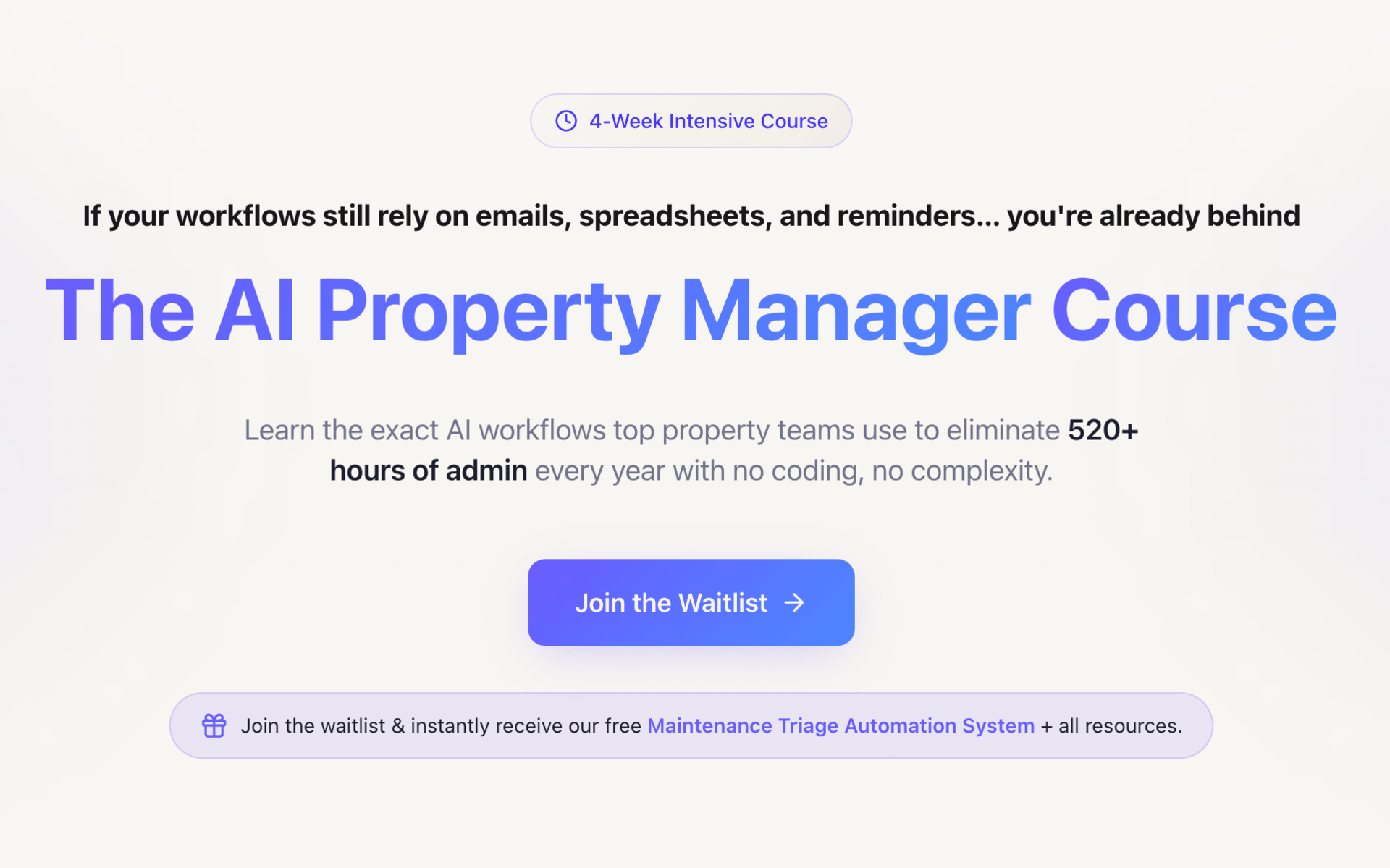
Join the Waitlist to Transform Your Property Operations & Scale Your Revenue
Your competitors are already automating: maintenance routing, resident comms, inspections, renewals, onboarding.
This 4-week course shows you how they’re doing it and how you can replace 10 to 20 hours/week of admin with clean, automated workflows that run themselves.
Everything is step-by-step.
Everything is ready to deploy.
Everything is built for actual PM workflows.
FREE BONUS 👇👇👇👇
Join the waitlist and get the complete Maintenance Triage Automation System immediately - your first automation, done for you, delivered to your email.
If you've already joined, there's nothing more to do!
We'll contact you real soon!
Founder Story of the Week: How Prop-AI Is Building the “Bloomberg of Real Estate”
Most property search tools are stuck in yesterday’s world: static listings, stale filters, and manual data gathering.
Prop-AI decided to rewrite the playbook.
Founded in 2023 in Dubai by Ranime El-Skaff and Christian Kunz, Prop-AI is on a mission to transform how properties are discovered, evaluated, and analysed using advanced artificial intelligence.
Rather than just listing buildings, Prop-AI builds machine-learning models that understand markets, risk, and value; a layer most PropTech platforms still ignore.
El-Skaff’s blunt observation was this:
“Real estate is the world’s largest asset class, yet remains one of the least digitised and data-driven markets.”
That insight became Prop-AI’s raison d’être: not just making tools, but building real-time intelligence that professionals can trust when markets shift.

What Prop-AI Actually Built
Prop-AI’s platform uses AI and machine learning to automate property search, evaluation, and decision-making. It goes beyond simple search filters by:
• Ingesting regional property records, pricing signals, and market trends
• Running valuation and risk models on demand
• Presenting predictive insights instead of static results
• Helping investors, agents, and operators make confident decisions in complex markets
Instead of “find me X” it answers “Which property will outperform, at what price, and why?” - a fundamentally different way of approaching real estate intelligence.
Why This Model Is Dangerous (in a Good Way)
Traditional property search and valuation tools treat data as static inputs:
✔ filters and checkboxes
✔ outdated maps
✔ ask-and-receive results
Prop-AI treats data as real-time signals that can be scored, compared, and predicted with machine intelligence. That means:
Better investment decisions: buyers/investors don’t just see listings, they see expected outcomes
Speed over research: AI crunches months of financing, pricing, and risk data in minutes
More confidence under uncertainty: markets rarely move in straight lines: AI models anticipate trends
This shifts the advantage from guesswork to data-driven certainty, something most operators still don’t have
The Results
Prop-AI recently secured a $1.5M pre-seed funding round led by Plus VC with participation from regional and global investors, signalling confidence in its data-first, AI-native vision.
That fundraising allows the team to deepen regional data integrations, scale its machine learning infrastructure, launch advanced enterprise tools, and expand across MENA and Europe - markets ripe for intelligent real estate products.
The Takeaway for Property Managers
Ranime El-Skaff didn’t build another search engine, he built a decision engine.
In an era where portfolio performance depends on timeliness, accuracy, and risk insight, Prop-AI points to a future where:
📌 Operators don’t just find opportunities, they predict them
📌 Decisions are rooted in real signals, not gut feel
📌 Markets become less opaque and more actionable
If your workflows still rely on portals, legacy MLS tools, or simple filters, you’re not just inefficient, you’re blind to predictive value that AI can unlock.
Prop-AI’s approach is a preview of the next phase in property tech, one where intelligence matters more than inventory.
How AI Starts Killing the Commission Agent Model

Over the next 10 years, most commission-based agents won’t be “replaced by robots” overnight.
They’ll just wake up one day and realise:
Buyers aren’t calling them first
Sellers aren’t paying 1–3% fees
And the work they used to do has quietly moved into software
This isn’t theory. It’s already happening in pieces, right now.
Let’s walk through what’s changing, step by step.
1. What Does a Human Broker Actually Do?
Strip away the branding. A typical agent/broker does five things:
Find people who want to buy or sell (lead generation)
Match people to properties (search + filtering)
Tour + explain (viewings + education)
Price + negotiate (valuation + offers + counteroffers)
Push the deal to completion (paperwork + coordination)
Now compare that list to what AI systems and modern platforms already do:
Lead gen: social ads, portals, retargeting, email funnels
Matching: AI search, recommendation engines, “people like you also viewed…”
Tours: video, 3D tours, AI-generated walkthroughs, voice-over guides
Pricing: AVMs (automated valuations), comp engines, dynamic pricing tools
Coordination: e-signatures, automated reminders, transaction checklists
The broker is no longer the only way to get any of this done.
They’re just a bundled package of services tech is unbundling, one feature at a time.
2. How AI Eats Each Piece of the Broker’s Job
A. Lead Generation → Algorithms Already Do It Better
Platforms already know who is “in-market” before the buyer calls anyone.
Browsing patterns, mortgage pre-approvals, search behaviour, email opens — all tracked.
In plain English:
The system knows who will buy or sell before an agent does.
Once platforms decide to route those leads to their own AI assistant rather than a human agent, the human never even sees the opportunity.
B. Matching Buyers to Properties → AI Is Built for This
Humans:
Ask a few questions
Use filters
Show a bunch of “maybe this?” options
Hope something sticks
AI:
Reads everything the buyer says
Understands budget, taste, trade-offs, lifestyle (schools, commute, noise)
Scores every property in the database by “fit”
Shows a shortlist that’s actually relevant
No filters, no portals, no scroll.
Just: “Here are 8 homes you’ll probably like, ranked by how much we think you’ll like them.”
Once buyers experience that once, going back to “3-bed in SW11 under £800k” filters feels like dial-up internet.
C. Tours and Education → AI Guides, 24/7
Right now:
Agents spend hours per week just opening doors and repeating the same explanations:
“Council tax is…”, “Leasehold means…”, “Yes, the boiler is new.”
AI can:
Generate a personalised script for each property and each buyer
Answer questions via chat or voice (“What’s service charge here?”)
Highlight issues honestly (noise, service charge, flood risk) because it has no commission bias
When combined with 3D tours and smart locks, you are a couple of steps away from fully self-guided viewings with an AI “host”.
D. Pricing + Negotiation → Data Beats Gut
Agents talk about “gut feel” on pricing.
AI doesn’t guess. It:
Looks at every sale and rental in the area
Adjusts for condition, floor, view, garden, noise, crime, schools
Models demand trends
Suggests: “List at £X, accept between £Y and £Z, expected time-to-sell 18 days.”
Negotiation?
Once both sides know the real market range, negotiation is just psychology. Even that can be coached by an AI:
“If you counter here, probability they walk is 12%. If you accept, you’re leaving ~£4k on the table.”
You don’t need “top negotiator energy” when the system lays out the likely outcomes.
E. Coordination → Software Is Already Better
The final 20–30% of the job (chasing lawyers, brokers, surveyors, lenders) is already mostly project management:
Who’s late?
Who needs a nudge?
Which documents are missing?
This is literally what workflow tools are best at.
AI agents can:
Watch every task
Auto-chase people via email/SMS
Escalate if deadlines slip
Keep everyone in the loop
Think “AI transaction coordinator” scanning the pipeline 24/7, doing what junior staff used to do.
3. The Real Story: Why Commissions Collapse
AI doesn’t just replicate each part of the broker’s job.
It changes the economics:
Lead generation becomes platform-owned
Matching becomes instant and better
Tours become self-service
Pricing becomes data-driven and transparent
Coordination becomes back-office automation
What’s left to justify 1–3% of the sale price?
You don’t pay 3% of car value to someone for “introducing you to a Tesla showroom”.
You don’t pay 5% of flight cost to a travel agent anymore.
Property is going the same way. Slowly at first. Then suddenly.
4. A Real, Current Example: AIR in Dubai
Dubai is already testing “what happens if we just remove agents from the picture?”
AIR launched as an AI-native brokerage.
No agents. No traditional commission-heavy model.
AI handles the whole flow: discovery, matching, underwriting, deal.
The value proposition:
Sellers: lower fees, faster sales.
Buyers: better matches, less noise, clear data.
Platform: keeps a smaller fee per transaction at much higher volume.
Think of AIR as the early version of what will be normal in 5–10 years:
“Talk to the system”
Get a shortlist
Book a viewing
Get an offer
Sign docs
No “my guy” needed.
5. What Actually Happens Over the Next 10 Years
It won’t be “robots firing all agents on a Tuesday”.
Instead, you’ll see:
Commission compression
1–3% becomes 0.5–1% for humans
AI-driven platforms charge a low, flat, predictable fee
Hybrid roles
Some humans stay in the loop, but as advisors, not gatekeepers
“I want a sanity check”, not “You control access”
Platform-first behaviour
Consumers start with AI assistants
Those systems decide whether a human even gets involved
Specialist survivors
Complex commercial, luxury, and distressed deals still use humans
But everyday residential transactions default to AI + platform rails
The job title doesn’t disappear.
The economic power does.
6. What This Means If You’re a Property Manager or Operator
If you sit on the operations side (PM, asset management, BTR, SFR, PBSA), this shift is good news:
You finally get direct access to demand instead of renting it from portals and brokers.
AI can route right-fit tenants and buyers straight into your systems.
You can negotiate lower fees or cut middlemen entirely.
Your leverage goes up if:
You own your data (tenant history, maintenance, response times).
You plug into AI discovery layers early.
You present as “AI-ready inventory” (clean data, live availability, clear pricing).
Your risk?
Staying dependent on humans who control the top of funnel.
Paying yesterday’s commissions for today’s AI-powered leads.
Final Takeaway
The next 10 years won’t be “robots versus agents”.
It’ll be platforms with AI versus individuals without it.
The platforms will own demand.
The AI will own matching and pricing.
Workflow engines will own coordination.
The human broker layer doesn’t vanish overnight.
It just gets thinner, more niche, and a lot less profitable.
If you’re a property manager or operator, the correct question isn’t:
“Will AI replace agents?”
It’s:
“How do I plug into the AI layer so I stop paying for the human one?”
Top PropTech Funding Rounds in 2025
Company | Region | Funding Round & Size | Focus |
|---|---|---|---|
Property Finder | Middle East (MENA) | $525M debt financing (Oct 2025) | MENA’s largest property portal; classifieds + search infrastructure |
EliseAI | Americas (USA) | $250M Series E (Q3 2025, reported) | AI leasing + resident communication + ops automation for multifamily |
Bilt Rewards | Americas (USA) | $250M growth round (Q3 2025, reported) | Rent payments + loyalty rewards; rent-to-equity financial infrastructure |
Entrata | Americas (USA) | $200M growth round (Blackstone-led, Q3 2025, reported) | End‑to‑end property management software for large multifamily portfolios |
Simplicity Living (BTR Programme) | Oceania (New Zealand) | ~NZD 500M (~$310M) development capital (Q2 2025) | Long‑term build‑to‑rent housing platform and pipeline |
Spark Data Centre Portfolio (Infra) | Oceania (New Zealand) | ~NZD 705M (~$435M) asset sale (Q1 2025) | Data‑centre real‑estate infrastructure critical to digital/AI workloads |
Precinct / Keppel PBSA JV | Oceania (New Zealand) | ~NZD 290M (~$180M) development JV (Q2 2025) | Purpose‑built student accommodation (PBSA) in Auckland (c.960 beds) |
Huspy | Middle East (UAE) | $59M Series B (Jun 2025) | Mortgage + transactions platform simplifying home buying across UAE & Saudi |
Buena | Europe (Germany) | €49M (~$58M) Series A (Jul 2025) | AI‑powered residential property operations and roll‑up platform |
Arbio | Europe (Germany) | $36M Series A (Oct 2025) | AI‑native short‑term rental and property management platform |