- The AI Property Manager
- Posts
- If Tenants Stop Finding You Tomorrow, Would Your Business Survive?
If Tenants Stop Finding You Tomorrow, Would Your Business Survive?
AI search, automated operations, and tenant-first models are quietly dismantling the property management status quo.
Here are the top 3 things in today’s edition:
Portals are losing control of discovery: AI search bypasses filters and paid placement, routing tenants directly to operators who own the workflow.
Tenant experience is now the growth engine: Models like Belong prove happy tenants mean higher retention, guaranteed rent, and zero churn from landlords.
Automation is no longer optional: Maintenance triage, leasing, and comms are becoming system-run manual operators are already falling behind.
THE COURSE YOU’VE BEEN ASKING IS ALMOST HERE!!!
Join the Waitlist to Transform Your Property Operations & Scale Your Revenue
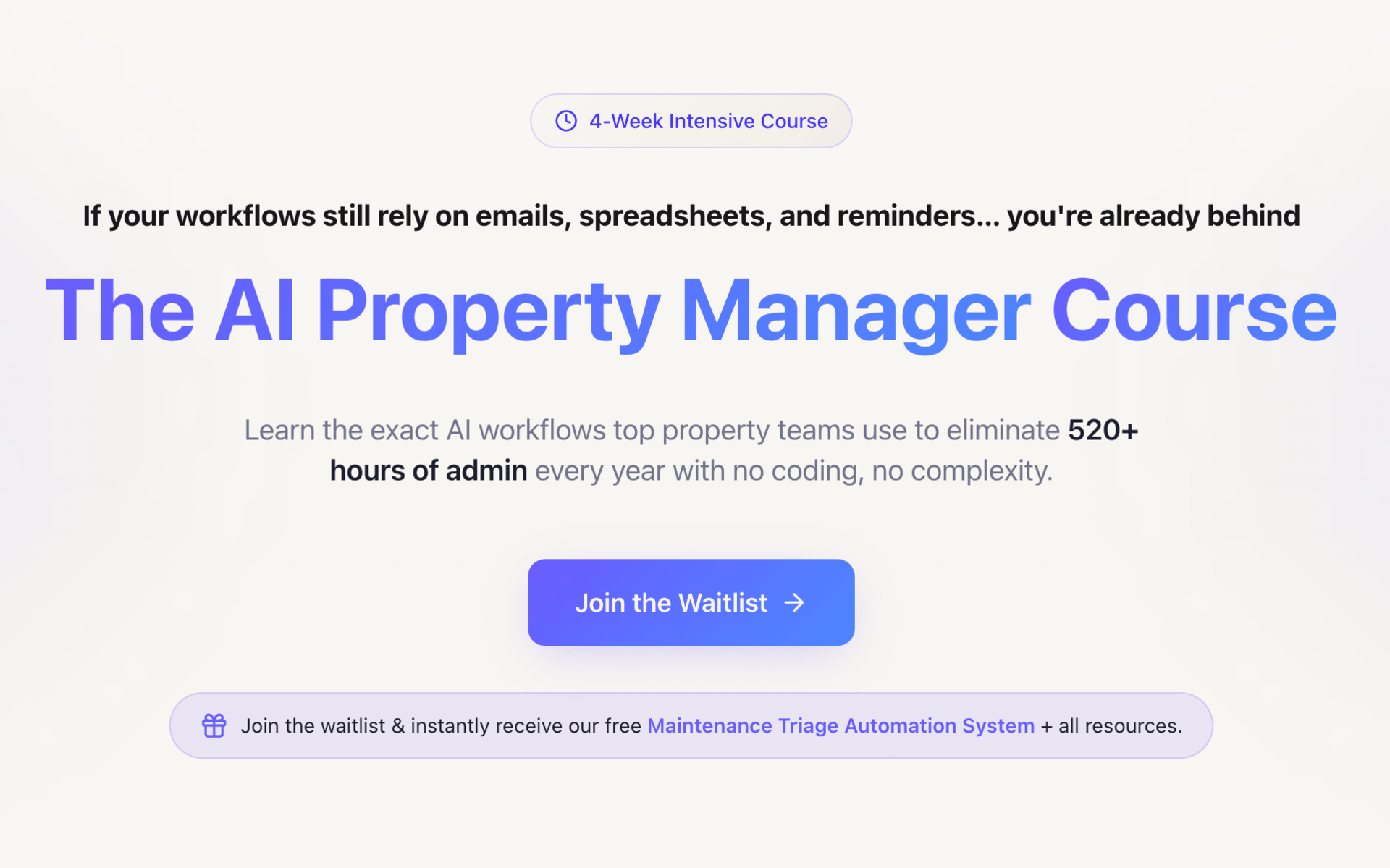
Your competitors are already automating: maintenance routing, resident comms, inspections, renewals, onboarding.
This 4-week course shows you how they’re doing it and how you can replace 10 to 20 hours/week of admin with clean, automated workflows that run themselves.
Everything is step-by-step.
Everything is ready to deploy.
Everything is built for actual PM workflows.
FREE BONUS 👇👇👇👇
Join the waitlist and get the complete Maintenance Triage Automation System immediately - your first automation, done for you, delivered to your email.
Founder Story of the Week: How Baselane Quietly Became the Bank for Landlords
Most PropTech startups try to bolt features onto broken systems.
Baselane did something smarter. They replaced the system entirely.
That’s the world Mathias Korder and team set out to change when they founded Baselane, a fintech-first operating system designed specifically for landlords and property investors.
His question was simple and uncomfortable:
“Why do landlords run real businesses on consumer bank accounts?”
So instead of building another PM tool, Korder built Baselane: a banking-first operating system designed specifically for landlords.
Not accounting.
Not screening.
Not maintenance.
Money.
And everything flows from there.

What Baselane Actually Built
Baselane isn’t a “nice dashboard” - it’s financial infrastructure for landlords.
It combines FDIC-insured banking, rent collection with flexible tenant payment options, automated expense categorisation, property-level accounting, real-time cash-flow and yield reporting, and tax-ready exports in one system.
Every rent payment, fee, repair, and expense is tied directly to each property and tracked automatically - no syncing, no reconciliation, no spreadsheets.
Why This Model Is Dangerous (in a Good Way)
Most Landlords Lose Money Without Realising It
Commingled accounts, missed deductions, delayed rent, poor cash visibility, and bad refinancing decisions quietly erode margins without ever showing up as a “problem.”
Property-Level Banking = Real Profit Visibility
Each property gets its own virtual account, so you can instantly see which assets are performing and which are bleeding cash.
Rent Collection That Feels Like Fintech
Tenants pay via ACH, card, or autopay. Late fees are automatic, receipts are logged, and reconciliation disappears.
Accounting Without Accountants
Expenses are auto-categorised in real time. No QuickBooks, no monthly clean-ups, no tax-time panic. Export tax-ready reports in minutes.
Financing-Aware by Design
Because Baselane understands debt, yield, and NOI, it helps landlords make smarter refinancing and acquisition decisions, not just track history.
The Results
Baselane has grown rapidly among independent landlords and small PMs managing 5–200 units.
The company raised $34.4M Series B to expand its landlord-focused financial stack.
(Source: TechCrunch, 2024)
Users report:
Faster rent collection
Cleaner books
Better visibility into underperforming assets
Fewer financial mistakes that quietly destroy margin
The Takeaway for Property Managers
Korder didn’t try to make property management easier.
He made it financially legible.
And that’s the real unlock.
If your PM business or landlord clients still run money through:
personal bank accounts
generic accounting tools
delayed reporting
You’re flying blind.
Baselane proves the next generation of property management isn’t built on features, it’s built on financial infrastructure that understands rentals from day one.
Fix the money layer, and everything else becomes easier to automate.
That’s not a tool upgrade.
That’s a category shift.
The Death of Portals & the Search Monopoly

Why AI Search Is Structurally Breaking Property Discovery?
Portals like Rightmove, Zillow, and Zoopla don’t own inventory. They own query routing.
That distinction matters because AI search breaks routing at the protocol level, not the UI level.
1. Traditional Property Search Is a Relational Database Problem
Portals are built on relational databases.
Search logic = SQL-style filters:
- price_min / price_max
- bedrooms = 2
- postcode IN (…)
- property_type = flat
This model assumes:
1) users know exactly what they want
2) preferences are static
3) all criteria are equally important
In practice, none of this is true.
Real users search with:
fuzzy constraints
tradeoffs
priorities
time sensitivity
lifestyle signals
This mismatch is why portals require:
sorting
scrolling
premium placement
paid boosts
Their business model depends on this friction.
Source: McKinsey, “The Future of Search Is Multimodal and Intent-Based” (2024)
2. AI Search Replaces Filters With Probabilistic Matching
Modern AI search systems don’t query rows — they score probabilities.
Instead of: WHERE price < £3,000 AND bedrooms = 2
AI systems use:
embedding models (vector similarity)
intent classifiers
constraint weighting
ranking by confidence, not exact match
Technically, this looks like:
Natural language input → embedding
Intent extraction (budget, urgency, lifestyle)
Constraint prioritisation (hard vs soft)
Candidate scoring
Ranked shortlist with confidence weighting
This is not something portals can bolt on without re-architecting.
Source: Google DeepMind, “From Keyword Search to Semantic Retrieval” & OpenAI, “Embeddings and Vector Search in Production Systems”
3. Why Portals Lose Control of the Funnel
Portals monetise exposure, not outcomes.
Portals Optimise for Revenue, Not Results
Their rankings are shaped by paid placement, advertiser priority, listing recency, and contract tiers not by who is most likely to convert.
AI Optimises for Outcomes
AI systems rank listings by match accuracy, conversion probability, response time, and real availability, the signals that actually close deals.
What Happens Next
Once AI sits between the user and discovery, portals shrink into raw data providers, not decision engines.
We’ve seen this movie before: Yelp lost to Google Maps, Expedia lost ground to direct airline bookings, and job boards lost power to LinkedIn’s AI matching.
Source: Andreessen Horowitz, “Marketplaces vs Systems of Record” & Harvard Business Review, “Why Platforms Lose Power When Intelligence Shifts”
4. The Technical Reason Portals Can’t Compete
No Real-Time State
AI needs live availability, real response times, maintenance backlog, and tenant demand signals. Portals work with static listings that are already out of date the moment they’re published.
No Feedback Loops
AI systems learn from engagement, drop-offs, and conversion outcomes. Portals don’t control transactions, so they never see what actually converts, only clicks.
No Local Context Graphs
AI search thrives on hyperlocal patterns, operator behaviour, vendor reliability, and response SLAs. National-scale portals flatten this signal, which is why AI-native challengers often convert better despite looking “worse” on the surface.
Source: MIT CSAIL, “Locality Bias in Recommendation Systems” & Stanford HAI, “Why Centralised Marketplaces Struggle With Context”
5. Why This Is an Economic, Not UX, Disruption
Portals make money by charging for: impressions, clicks & lead forwarding
AI search makes money by: owning the decision layer, routing to the right operator and improving close rates
Once: leads convert faster, vacancy drops and CAC falls
Operators stop paying for exposure.
This is exactly how:
programmatic ads displaced classifieds
recommendation engines displaced directories
Source: Benedict Evans, “From Aggregators to Algorithms” & PwC, “AI and the Collapse of Attention-Based Pricing Models”
6. What Replaces Portals (Technically)
The winning architecture looks like this:
AI Search Layer
↓
Property Management System (inventory, availability, pricing)
↓
Workflow Engine (leasing, comms, maintenance)
↓
Transaction & Feedback Loop
This is why:
PMS platforms are adding AI
AI startups are building inventory connectors
portals are scrambling to rebrand features as “AI”
The system that owns the workflow wins search.
7. The World-Changing Consequence
Discovery becomes: conversational, local and outcome-driven
Not: browse-based, national or pay-to-play
That means:
local PMs regain leverage
lead quality improves
monopolies erode quietly
margins shift downstream
Portals won’t “die.”
They’ll become background infrastructure.
Like Yellow Pages did.
Final Takeaway
This isn’t about better listings.
It’s about who controls intent.
AI search doesn’t disrupt portals by competing with them, it bypasses them entirely.
And once users stop starting their search on portals, the monopoly is already over.
The 10 Property Tech Companies Quietly Building the Next Real Estate Infrastructure in 2025
Company | Region | Valuation / Total Funding | Core Focus |
|---|---|---|---|
Bilt Rewards | USA | ~$10.7B valuation / ~$813M raised | Rent payments + rewards platform; turns rent into loyalty and payments infrastructure |
QuintoAndar | Brazil | ~$5.1B valuation / ~$755M raised | End-to-end rental + sales platform (leasing, guarantees, financing) |
Ziroom | China | ~$6–7B valuation / ~$2.1B raised | Tech-enabled rental housing operator and property management |
Lessen | USA | ~$2B valuation / ~$735M raised | AI-driven maintenance, renovation & vendor ops for large portfolios |
HomeLight | USA | ~$1.7B valuation / ~$762M raised | AI-powered home transactions, agent matching, and bridge financing |
Mofang Gongyu | China | ~$1B valuation / ~$650M raised | Managed rental apartments with smart building operations |
NoBroker | India | ~$1B valuation / ~$380M raised | Broker-free rental & sales platform with community management tools |
Hostaway | Global (Canada/EU) | ~$925M valuation / ~$535M raised | Vacation rental operations & automation platform |
Guesty | Israel / Global | ~$900M valuation / ~$410M raised | Enterprise PMS for short-term rental operators |
Casavo | Europe (Italy) | ~$500M est. valuation / ~$800M raised (equity + debt) | AI-assisted home buying/selling marketplace |