- The AI Property Manager
- Posts
- Can Your Property Business Survive 2026 Without AI?
Can Your Property Business Survive 2026 Without AI?
How AI quietly replaced inboxes, admin teams, and entire workflows while most operators weren’t looking.
THE COURSE YOU’VE BEEN ASKING IS ALMOST HERE!!!
Join the Waitlist to Transform Your Property Operations & Scale Your Revenue
Your competitors are already automating: maintenance routing, resident comms, inspections, renewals, onboarding.
This 4-week course shows you how they’re doing it and how you can replace 10-20 hours/week of admin with clean, automated workflows that run themselves.
Everything is step-by-step.
Everything is ready to deploy.
Everything is built for actual PM workflows.
FREE BONUS 👇👇👇👇
Join the waitlist and get the complete Maintenance Triage Automation System immediately - your first automation, done for you, delivered to your email.
How Property Management Actually Runs in 2026
In 2026, AI in property management is no longer experimental. It is operational infrastructure. The teams pulling ahead are not “trying tools.” They are redesigning how work flows through their business.
What follows is what modern property operations actually look like on the ground.
Leasing That Never Sleeps
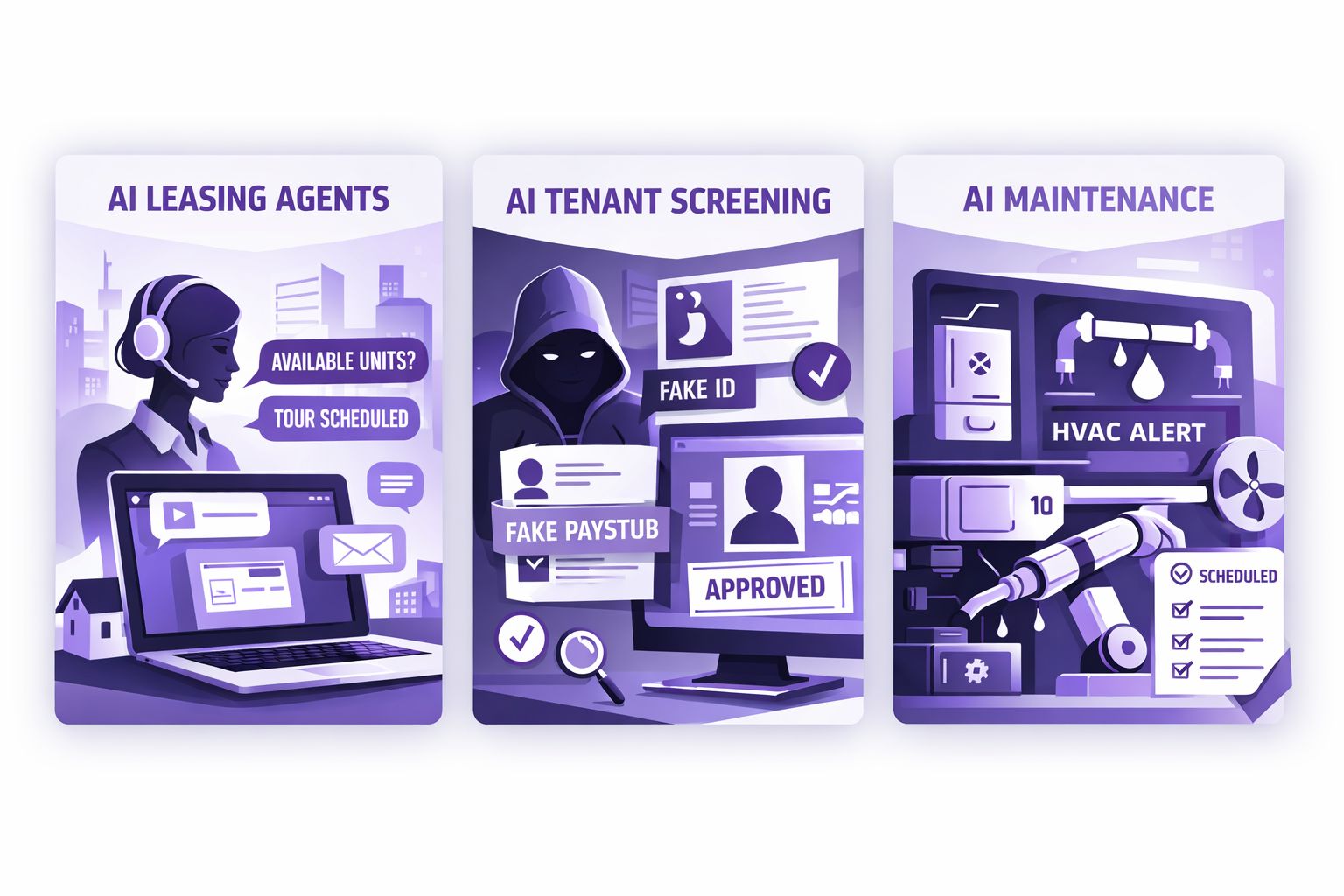
AI leasing agents are now the default first point of contact across portfolios.
Every enquiry, whether it comes from a portal, website chat, email, or WhatsApp, is handled instantly. Prospects get answers about pricing, availability, policies, and viewing times in seconds, not hours. Every interaction is logged directly into the CRM or property management system.
Leads are automatically qualified using preset criteria like income bands, move-in timelines, and household size. The system proposes tour slots and books physical or virtual viewings directly into calendars without staff involvement.
Once a prospect is ready, AI guides them through applications, extracts data from uploaded documents, flags missing information, and pushes completed files into leasing systems.
In 2026, renters expect instant answers. Property managers who still rely on manual responses are losing leads before their team even opens an inbox. The new baseline is simple: no enquiry waits more than 60 seconds for a response.
Tenant Screening and Fraud Detection
Applicant fraud has evolved. Fake pay stubs, synthetic identities, and manipulated PDFs routinely bypass manual review. AI screening is now essential, not optional.
Modern screening systems automatically analyze bank statements, IDs, and income documents. They detect inconsistencies in formatting, metadata, and financial patterns that indicate tampering.
Beyond credit scores, AI models assess rental payment history, employment stability, sector risk, and communication behavior. Screening decisions are explainable and increasingly built to comply with fair-housing and anti-discrimination regulations.
The result is a shift from intuition-driven approvals to systematic, auditable decisioning that reduces bad debt and eviction risk while staying compliant.
Maintenance Moves From Chaos to Prediction
Maintenance is one of the highest-ROI AI deployments in property operations.
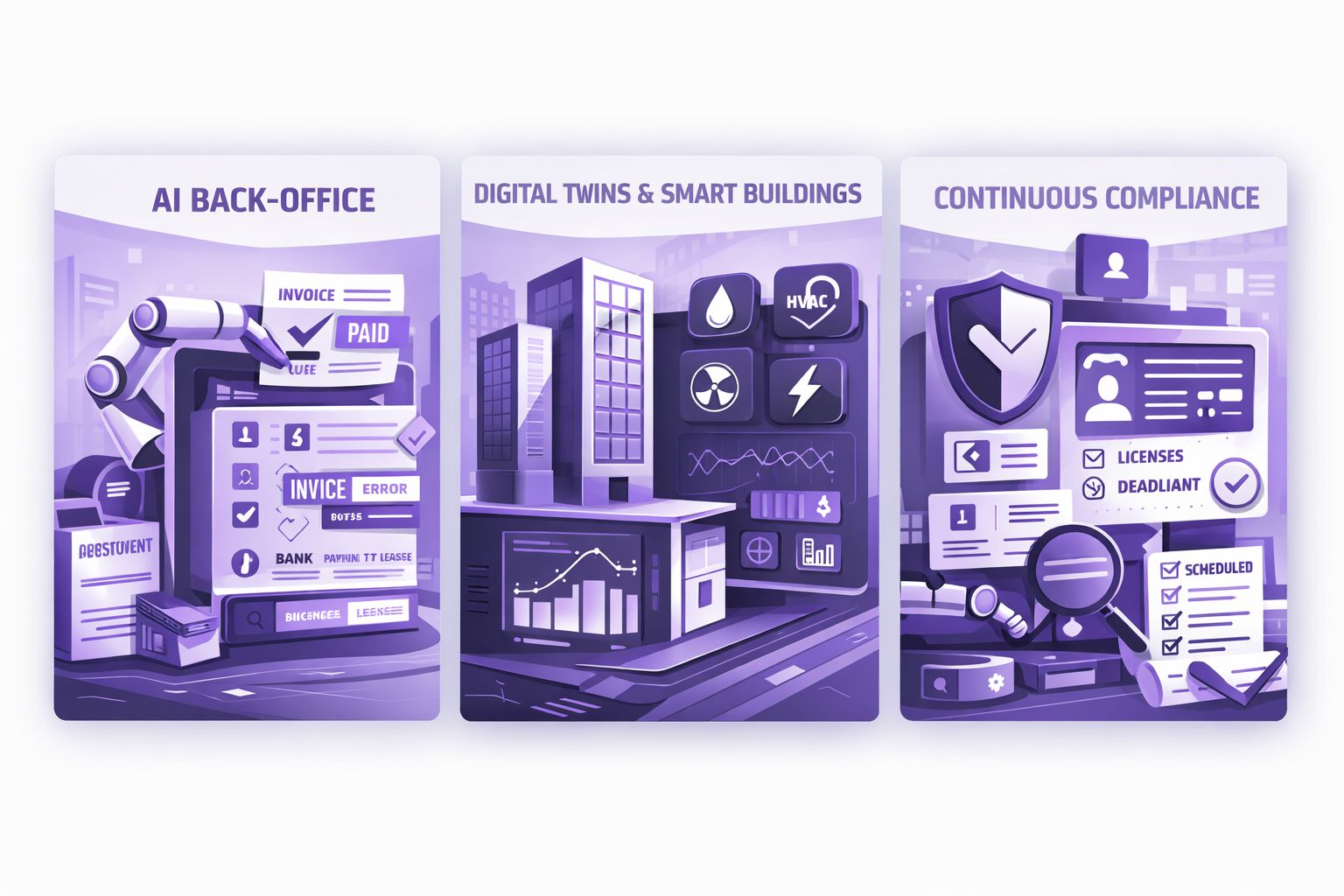
Every request, whether submitted by app, email, chat, or voice, is automatically classified. The system reviews unit history, assigns urgency, and routes the job to the appropriate vendor or internal team.
Predictive maintenance is becoming standard in larger portfolios. HVAC anomalies, boiler efficiency drift, moisture patterns, and energy spikes are flagged before failures happen. Work is scheduled during business hours instead of at 3 a.m.
AI systems now coordinate vendor scheduling, access logistics, arrival tracking, resident updates, and post-completion feedback. Work orders close themselves and update warranties, costs, and maintenance records automatically.
For portfolios over 500 units, email-based work orders are no longer competitive. Predictable maintenance is now the expectation.
The critical insight is that workflows improve not because AI is “smart,” but because it enforces structure. Every task has a state. Every state has rules. Every rule has escalation paths.
Accounts Payable, Receivable, and Back Office Automation
Back-office operations are where AI quietly delivers some of the biggest wins.
Invoices are captured automatically from PDFs or photos. Line items are extracted, coded to the correct GL accounts, and posted into accounting systems with minimal human review.
Payments are matched to leases and invoices. Exceptions are flagged intelligently instead of forcing teams into month-end reconciliation marathons.
Rent collection is proactive rather than reactive. AI predicts who may miss payments, sends tailored reminders before due dates, offers structured repayment paths, and logs all interactions for compliance.
The impact is fewer errors, cleaner books, and real-time visibility into cash flow without constant manual intervention.
Buildings Become Systems, Not Addresses
Digital twins and smart building platforms are moving into daily operations.
A single dashboard aggregates HVAC performance, access logs, occupancy data, energy usage, and asset health. AI highlights anomalies, forecasts failures, and simulates operational changes before they are implemented.
Energy optimization is increasingly automated. AI recommends HVAC schedules, demand-response participation, and retrofits based on payback models, then turns those recommendations into executable tasks.
Safety and compliance monitoring runs continuously. Certificates, inspections, alarms, and access patterns are tracked in real time, with risks flagged before incidents occur.
Property managers shift from reacting to complaints to monitoring building health.
Compliance Becomes Continuous
Compliance failures are no longer caused by ignorance. They are caused by poor systems.
AI now manages right-to-rent checks, identity verification, and KYC workflows. It maintains calendars for inspections, licenses, safety checks, and regulatory obligations at the property level.
Agentic systems diagnose upcoming compliance risks, prioritize tasks by severity, generate required documents, and maintain audit trails automatically.
Instead of discovering expired certificates after the fact, teams stay ahead of regulators by design.
Portfolio Strategy Gets Smarter
AI is changing how property managers think about performance.
Rent and fee strategies are dynamically recommended using local demand, seasonality, asset condition, and churn risk. Pricing becomes unit-level, not portfolio-wide guesswork.
Underperforming assets are flagged automatically based on maintenance outliers, churn patterns, and rent gaps. AI proposes targeted interventions such as CAPEX adjustments or repositioning strategies.
Owner reporting shifts from static PDFs to narrative explanations. Reports explain why costs changed, what actions improved NOI, and where risks are emerging.
This is where property managers start operating like portfolio CFOs rather than reactive operators.
How Leading Property Managers Sequence AI Adoption
In 2026, the rollout pattern is consistent across top operators.
First, they clean their data and reduce tool sprawl. Systems are integrated through APIs and core data becomes reliable.
Next, they deploy AI leasing assistants and accounts payable automation. These deliver immediate ROI with low operational risk.
Maintenance automation follows, starting with triage and routing before expanding into predictive models.
Continuous compliance systems are layered in next, with humans retained for oversight and escalation.
Finally, advanced analytics and portfolio optimization tools are introduced once operational data is clean and trustworthy.
The best property managers in 2026 are not experimenting with AI. Their daily experience is fundamentally different.
Inboxes are quieter. Dashboards are clearer. Tenants get answers instantly. Vendors know where to be. Owners see fewer surprises and more strategy.
AI is not replacing property managers. It is removing the parts of the job nobody wanted and turning the role into a higher-leverage, more strategic profession.
The operators who internalize that now will own the next cycle.
Want to learn how to automate your entire operation step-by-step?
You’re going to want this one, it’s a game-changer.